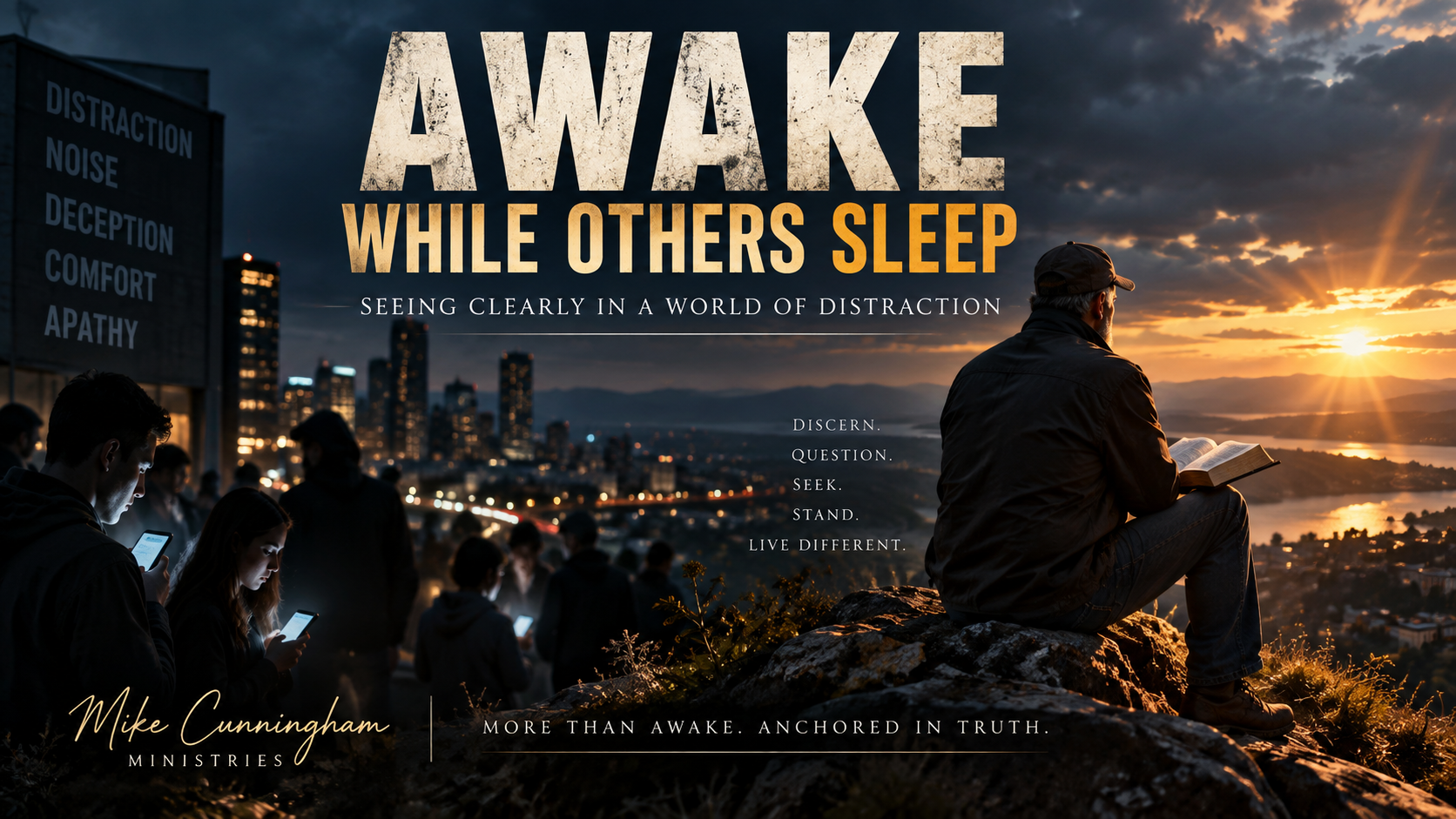
Seeing Clearly in a World of Distraction
By Mike Cunningham Ministries
Have you ever looked at a situation and wondered, Why doesn't anybody else see what I see?
Sometimes you notice the small inconsistency everyone else passes over. You hear something that doesn't quite fit. You see a connection between events that others treat as unrelated. You look at a decision being made today and can already imagine where it may lead tomorrow.
That can be intelligence. It can be experience. It can be simple observation. But for the Christian, there is another word that deserves our attention:
Discernment.
We live in a world overflowing with information but often starving for wisdom. We are surrounded by headlines, opinions, social media, advertising, entertainment, arguments and voices competing for our attention.
Being awake spiritually doesn't mean believing every conspiracy, distrusting everyone around us, or assuming we possess some special knowledge unavailable to everyone else.
It means learning to look beyond appearances, test what we hear, recognize what is true, and remain anchored in God while doing it.
Seeing What Others Miss
The human mind is remarkably good at recognizing patterns.
Experience gives us a mental library. Something happens today, and without consciously thinking about it, our mind compares it with things we have seen before.
A mechanic may hear an engine and immediately know something isn't right. A mother may hear a slight difference in her child's voice and know something is wrong. An experienced businessman may look at a proposal and spot a problem others overlooked.
The same principle can operate in everyday life.
Some people naturally pay close attention to details. They notice changes in tone, inconsistencies in behavior, missing information and things that simply don't fit.
But Scripture teaches us that spiritual discernment must also be developed.
Hebrews 5:14 speaks of those who have had their senses exercised to “discern both good and evil.”
Notice that word: exercised.
Discernment isn't merely something we claim to possess. It is something that must be developed, tested and disciplined.
That brings us to an important warning.
Seeing patterns doesn't necessarily mean the pattern we see is real.
We can overanalyze. We can make assumptions. We can connect dots that don't actually belong together. We can become so convinced of our own perception that we stop listening to anyone else.
That's why genuine discernment requires humility.
First John 4:1 tells us:
“Beloved, believe not every spirit, but try the spirits whether they are of God...”
In other words: test it.
Don't believe something merely because someone says it.
But don't believe it merely because you think it, either.
When Shallow Living No Longer Satisfies
As we grow older—and hopefully wiser—something else can happen.
Shallow conversation and meaningless activity can become increasingly unsatisfying.
There is nothing wrong with friendly small talk. Human relationships often begin with simple conversations. But there is a difference between simplicity and emptiness.
Eventually we begin asking larger questions:
What really matters?
What am I doing with the time God has given me?
Are the things occupying my attention actually worth my attention?
Scripture repeatedly warns us about empty words and meaningless pursuits. Colossians 4:6 gives us a better standard:
“Let your speech be always with grace, seasoned with salt...”
Notice the balance.
Truth and grace.
A desire for substance should never make us arrogant. Depth without love can become hardness. Discernment without compassion can become criticism.
Being awake doesn't mean looking down on those who aren't where we are.
It means being willing to bring light where we can.
Think for Yourself—but Remain Teachable
There is another characteristic common among people who value discernment: they don't like being manipulated.
They question things.
They want to know why.
They are reluctant to follow someone merely because that person has a title, position or microphone.
There is something healthy about that.
First Thessalonians 5:21 says:
“Prove all things; hold fast that which is good.”
Christianity was never intended to require us to turn off our minds.
But independent thinking has its own danger.
There is a tremendous difference between refusing manipulation and refusing all authority. A person can become so determined not to be controlled that he becomes unwilling to receive correction, wisdom or counsel from anybody.
That isn't discernment.
That's pride.
We should test what we're told. We should compare it with Scripture. We should examine the evidence. But we should also remain teachable.
Stand firm, but remain humble enough to learn.
Sometimes Truth Makes People Uncomfortable
Have you ever noticed that you don't necessarily have to say anything to make another person uncomfortable?
Sometimes simply living according to your convictions creates a contrast.
Jesus spoke repeatedly about light and darkness. John 3:19 says that light came into the world, yet people loved darkness rather than light because their deeds were evil.
Light reveals.
But here again we must be careful.
Not every disagreement is persecution.
Not everyone who dislikes us is reacting to our righteousness.
And not every negative reaction has some deep spiritual meaning.
Sometimes we're simply wrong.
Sometimes we've spoken harshly.
Sometimes another person is having a bad day.
And sometimes two people simply don't agree.
True discernment leaves room for that possibility.
Before assuming someone else is the problem, the spiritually mature Christian should be willing to ask:
“Lord, is there something in me that needs correcting?”
That's part of being awake too.
Seeing Where Things Are Going
Some people naturally think several steps ahead.
Instead of asking only, “What is happening?” they ask:
“Where will this lead?”
Scripture recognizes the value of foresight.
Proverbs 22:3 says:
“A prudent man foreseeth the evil, and hideth himself: but the simple pass on, and are punished.”
Wisdom considers consequences.
A decision that seems harmless today may have enormous consequences five years from now. A small compromise can become a habit. A financial decision can become a burden. A neglected relationship can become a broken one.
Looking ahead can protect us from unnecessary trouble.
But constantly living tomorrow in our minds creates another danger.
Jesus said in Matthew 6:34:
“Take therefore no thought for the morrow: for the morrow shall take thought for the things of itself.”
There is a balance here too.
Prepare for tomorrow without surrendering today to worry.
We can see trouble coming and prepare wisely, but ultimately there are things we cannot control.
Those belong to God.
The Power That Comes From Within
Some people need encouragement before they move.
Others seem to carry an internal engine.
They don't need applause. They don't require constant recognition. If there is work to be done, they do it whether anyone is watching or not.
That kind of self-motivation can accomplish remarkable things.
But the Christian eventually has to ask a deeper question:
What is powering that engine?
Colossians 3:23 says:
“And whatsoever ye do, do it heartily, as to the Lord, and not unto men.”
There is an enormous difference between being driven by ego and being driven by purpose.
Self-reliance eventually reaches its limit.
God never intended us to prove that we don't need anybody. Even the strongest person needs wisdom, fellowship, correction and—above everything else—God.
Proverbs 11:14 reminds us:
“Where no counsel is, the people fall: but in the multitude of counsellors there is safety.”
Strength doesn't mean refusing help.
Sometimes strength means being wise enough to accept it.
Death Changes the Way We Look at Life
There is one reality that puts everything else into perspective.
Death.
We don't particularly enjoy talking about it. Our culture often tries to hide it, soften it or postpone thinking about it.
But ignoring death doesn't make it disappear.
Ecclesiastes 12:7 says:
“Then shall the dust return to the earth as it was: and the spirit shall return unto God who gave it.”
And Hebrews 9:27 tells us:
“It is appointed unto men once to die, but after this the judgment.”
That truth should not merely make us think about dying.
It should make us think seriously about living.
If our days on this earth are limited, then what deserves those days?
What deserves our attention?
What deserves our energy?
What arguments aren't worth having?
What grudges aren't worth carrying?
What relationships need repairing?
What has God been calling us to do that we keep postponing?
For the Christian, death does not have the final word. Jesus Christ died and rose again, and because of Him there is hope beyond the grave.
That changes how we live on this side of it.
Discernment Needs an Anchor
When we put all of these things together—observation, independent thinking, dissatisfaction with shallow living, foresight, inner motivation and spiritual awareness—we arrive at one central principle:
Discernment must have an anchor.
Without humility, discernment can become suspicion.
Without love, depth can become hardness.
Without fellowship, independence can become isolation.
Without faith, foresight can become worry.
Without God, self-motivation can become self-reliance.
That's why Proverbs 9:10 remains so important:
“The fear of the Lord is the beginning of wisdom...”
Being spiritually awake doesn't mean believing we know everything.
In many ways, it means recognizing how much we don't know.
It means testing what we hear.
Testing what we see.
And sometimes testing our own conclusions.
It means asking God for wisdom before assuming our instincts are always correct.
It means being courageous enough to stand alone when truth requires it—and humble enough to admit when we were wrong.
Stay Awake
The world will always provide distractions.
There will always be another headline, another controversy, another argument and another voice demanding our attention.
Don't confuse noise with truth.
Don't confuse popularity with truth.
Don't even confuse your own certainty with truth.
Test everything. Hold firmly to what is good. Stay grounded in the Word of God.
Pay attention to what is happening around you, but don't allow it to consume you.
Look ahead, but don't forget to live today.
Think independently, but remain teachable.
Stand for truth, but speak it with love.
And when everyone around you seems distracted by the noise of the world—
stay awake.
Because the greatest question isn't simply whether you can see what others miss.
The greater question is:
What will you do with what God allows you to see?
Evangelist Mike Cunningham
Mike Cunningham Ministries