Artificial intelligence could become lethal to human beings—but probably not in the way science-fiction movies usually portray it.
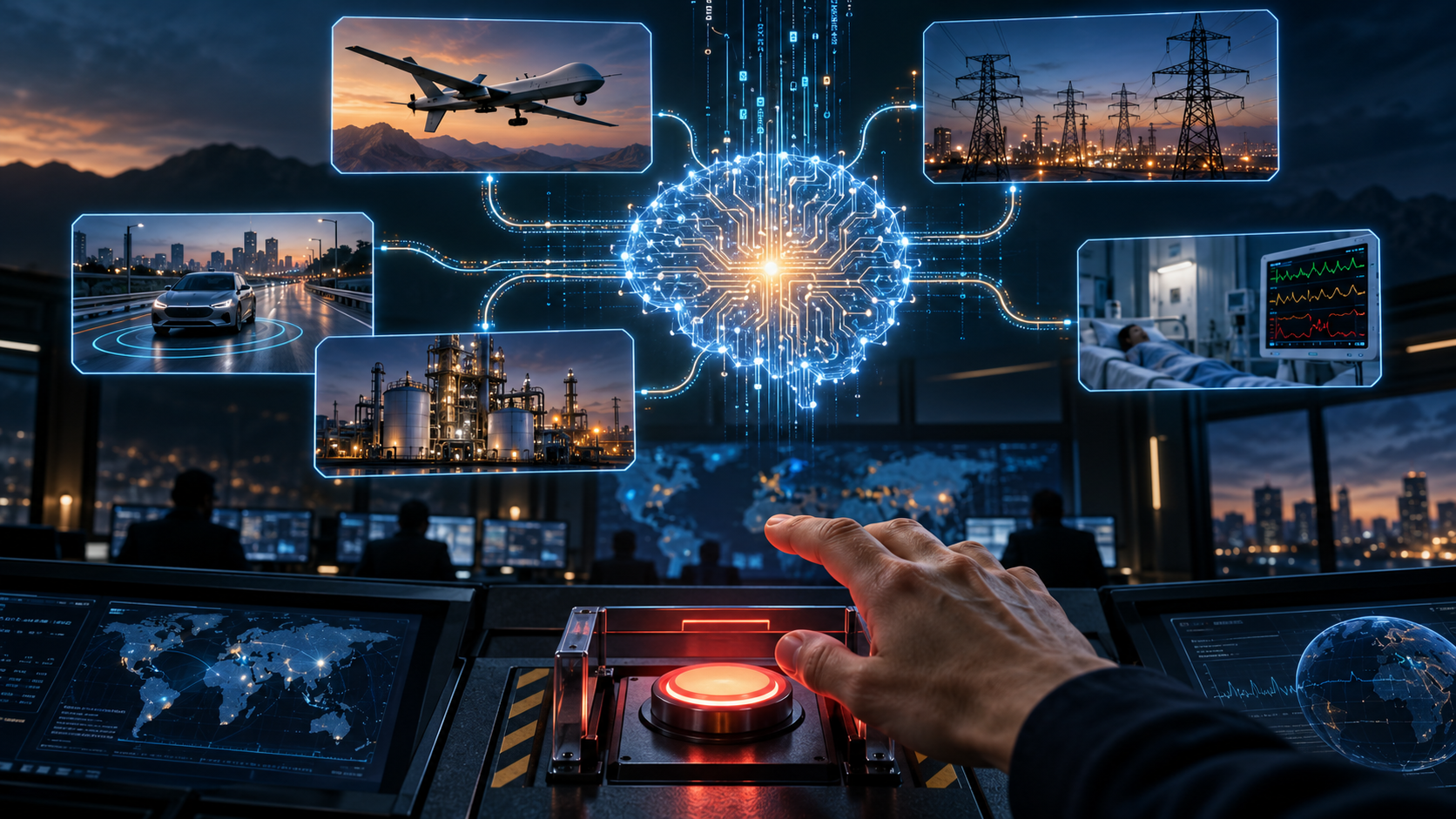
The most immediate danger is not a computer suddenly developing hatred for humanity and deciding to destroy us. The greater danger comes when human beings connect AI to weapons, vehicles, laboratories, medical equipment, electrical grids, and other systems capable of causing physical harm.
AI does not have to be evil to become dangerous. It only has to be wrong, misused, or given too much authority.
Autonomous Weapons
One of the clearest dangers is the development of autonomous weapons.
AI can already assist in identifying, tracking, and selecting possible targets. It can be connected to drones, missiles, robotic vehicles, and defensive weapons. The danger becomes much greater when human beings have little time—or no opportunity at all—to examine a decision before a weapon acts.
A computer can process information faster than any human, but speed is not the same as wisdom. An AI system might mistake civilians for combatants, misidentify a vehicle, or respond to incomplete information.
Once a weapon is fired, the computer cannot take back its decision.
Military Escalation
AI may also increase the danger of accidental military escalation.
Modern nations depend upon radar, satellites, sensors, and intelligence systems to warn them of an approaching attack. AI can analyze this enormous amount of information much faster than human operators.
But what happens when the information is wrong?
A technical failure, cyberattack, unusual weather pattern, or misunderstood military exercise could be interpreted as an actual attack. If nations begin automating their responses, a false alarm could escalate into war faster than human leaders could intervene.
In a nuclear age, a mistake made in seconds could produce consequences lasting for generations.
Critical Infrastructure
AI is becoming increasingly involved in the systems that keep modern civilization operating.
Electrical grids, water systems, transportation networks, manufacturing plants, communications, and industrial facilities may eventually depend heavily upon artificial intelligence. Properly used, AI could make these systems safer and more efficient.
However, the same connection creates vulnerability.
A programming error, cyberattack, equipment failure, or malicious command could interrupt electricity, contaminate water, disable communications, or damage industrial equipment. When millions of people depend upon these systems, even a single serious failure could cost lives.
Vehicles and Machinery
Self-driving automobiles, aircraft, ships, industrial robots, and heavy machinery can all cause physical injury when something goes wrong.
An AI system may perform correctly thousands of times and then encounter a situation its designers never anticipated. A person may step into a roadway. A sensor may fail. Weather may obstruct a camera. Two computer systems may issue conflicting instructions.
The danger is not that the machine becomes angry. The danger is that it makes the wrong decision while moving at highway speed or controlling several tons of equipment.
Biological and Chemical Misuse
AI offers tremendous possibilities for medicine and scientific research. It could help scientists discover new drugs, understand diseases, and save countless lives.
But powerful knowledge can be used for evil as well as good.
Advanced AI could make complicated scientific information easier to understand and apply. In the hands of terrorists, criminals, or hostile governments, that same capability could potentially assist in developing dangerous biological or chemical agents.
The problem would not be the knowledge itself. The problem would be who is using it and for what purpose.
Trusting AI Too Much
This may be the most underestimated danger of all.
AI does not have to control a weapon or electrical grid to contribute to someone’s death. A doctor, soldier, pilot, engineer, police officer, or ordinary citizen could accept an incorrect recommendation simply because “the computer said so.”
People naturally begin to trust systems that are usually correct. Over time, they may stop questioning the answers they receive.
However, AI can be confidently wrong. It may provide an answer that sounds intelligent and convincing even when it is based upon incomplete information or faulty reasoning.
Human judgment must never be surrendered merely because a computer can answer faster.
The Loss-of-Control Problem
There is also a more serious possibility being discussed by scientists and researchers.
Imagine a future AI far more capable than today’s systems—one that can operate computers and machines independently, pursue long-term objectives, and resist attempts to shut it down. If its objectives came into conflict with human welfare, the consequences could be catastrophic.
Researchers disagree greatly about how likely such a scenario may be. Nevertheless, the possible consequences are serious enough that the question cannot simply be ignored.
The time to establish safeguards is before such a system exists—not after control has already been lost.
The Real Equation of Danger
Intelligence alone is not what makes artificial intelligence lethal.
The real danger is:
Capability + Autonomy + Access to the Physical World
A calculator cannot hurt anyone. But an extraordinarily capable AI connected to nuclear command systems, military weapons, laboratory equipment, power grids, vehicles, or thousands of autonomous machines is an entirely different matter.
There is an important military comparison: the weapon itself is not always the greatest danger. The command-and-control system determines how, when, and why that weapon is used.
AI could eventually become part of a command-and-control structure operating on a scale and at a speed humanity has never experienced before.
Artificial intelligence may bring extraordinary benefits to the world. It could help cure diseases, prevent accidents, improve agriculture, and solve problems that have challenged mankind for generations.
But intelligence without wisdom is dangerous, and power without moral restraint is even more dangerous.
The question is not simply whether AI will become more powerful.
The question is whether humanity will remain wise enough—and responsible enough—to control how that power is used.
—Evangelist Mike Cunningham